


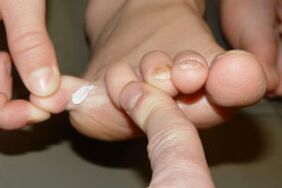
Fungus on the skin of the toes or podiatry is a skin disease.It affects people regardless of age.
A common form of mycosis on the toes is accompanied by unpleasant symptoms for the patient: itching, burning, peeling.
As the spores multiply, the fungus spreads to the skin of the feet and nails, penetrates into the bloodstream through micro-tears, and spreads through the bloodstream to all internal organs.
Treatment options are based on concomitant disease, site, and type of infection.Prevention can increase the likelihood of long-term remission.
To successfully get rid of harmful microorganisms, you need to understand what foot fungus looks like, why it occurs, and how to fight it.
What kind of fungus grows on toes?
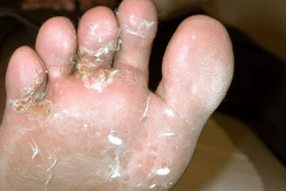
Toe mycosis is caused by the pathogenic anthropophilic microorganism tinea pedis.
Less commonly, the causative agents of the disease are molds and yeast-like fungi of the genus Candida.
The fungus' favorite habitat is the folds of skin between the fingers, where it is warm and moist.
As the microbial spores multiply, they also spread under the toes and then throughout the foot.
Primary infections with fungi occur in public places: bathrooms, swimming pools, saunas and gym locker rooms.
Microorganisms tolerate cold temperatures and dry surfaces well; they can survive for long periods of time in clothing, carpets, shoes, and, under the right circumstances, stick to the skin of the feet.
Often, the spread of microorganisms occurs within households through the use of shared hygiene products, slippers, and manicure tools.
Once inside the skin, the microorganisms remain dormant for long periods of time.When favorable conditions arise, i.e. when the immunity of the infected person decreases, the spores begin to actively grow
Mycosis begins to develop almost immediately if the spores come into contact with the skin of a person suffering from a chronic disease or who does not observe hygiene rules.
Knowing what fungus looks like on fingers is especially important for patients with chronic illnesses, as they are more susceptible to pathogens.
Risk groups include patients with:
- Endocrine system dysfunction;
- Poor blood circulation in the limbs and varicose veins;
- Flat feet, which increase skin friction;
- systemic stress;
- Periods of hormonal changes in the body: pregnancy, menopause, puberty;
- Inflammation of the lymphatic system;
- Decreased immunity after surgery or trauma.
Sweating feet, shoes made of synthetic materials, and microtrauma to the skin can promote fungal growth.
Malnutrition creates favorable conditions for the growth of spores: abuse of sweets, starchy, fatty foods and alcoholic beverages.
Toe fungus is rarely diagnosed in children.The main cause of fungal diseases in children is lack of hygiene.
Symptoms and forms of the disease
You can suspect a foot infection in its earliest stages, even before visual symptoms of fungal disease appear.The first sign of infection is peeling and itching of the skin.
When microorganisms begin to penetrate the epidermis, the surface of the finger becomes covered in small scales and cracks.
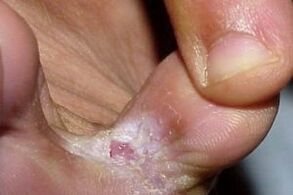
A bad smell comes from my feet.Specific symptoms depend on the form of the disease:
- Deleted.Small cracks and light flaking may occur under fingers and on surface.
- Squamous hyperkeratosis.Severe itching, burning sensation, and white scabs forming on fingertips.
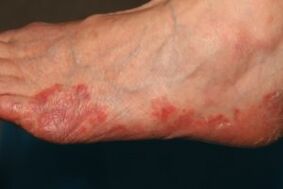
- rub against each other.Swelling of the skin, redness, moisture formation between the fingers, peeling of the skin, and the formation of deep cracks occur.
- Sweating disorders.It presents as a rash of small blisters filled with serous fluid.Severe itching, erosion forming at the ruptured blisters, and inflammation of the entire foot.
Important!In the later stages of the disease, the fungus penetrates the nail surface and begins to change its color and structure.Nails are speckled with color, deformed and chipped.
diagnosis
When the first clinical symptoms of a contagious infection appear, you should consult a doctor for diagnosis.
Although the symptoms of the fungus are clearly visible even in photos, only experts can identify the specific pathogen.
Patients undergo laboratory testing:
- Microscopic examination of skin granules.
- Bacterial cultures were performed on blister scrapings and fluid.
- DNA research on biological materials.
- blood test.
treat
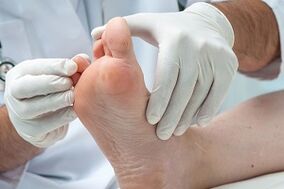
Initial treatment of finger fungus is not difficult.
The main measures are careful skin hygiene and treatment with local antifungal medications.
In the later stages of the development of a fungal infection, doctors will prescribe oral antifungal medications.
Folk remedies and physiotherapy procedures are used as complementary medicines.
You can cure fungus on your toes without cutting back on your prescription medications by carefully following your doctor's recommendations.
drug treatment
Pharmacological treatment involves the use of two groups of drugs:
- External preparations: ointments, creams, gels, sprays;
- Oral preparation.
Important!Complex treatments also include special diets, taking immune boosters and methods to restore the intestinal microbiota.Ointments are also needed when secondary infections are associated with inflammation.
physical therapy
Physical therapy procedures complement medical treatments and speed up the healing process:
- Ultraviolet rays irradiate the skin.The rays penetrate the skin to a depth of 0.6 mm and kill fungal spores within it.Session duration is 15-20 minutes.In the early stages of infection, the use of UV light eliminates the need for antifungal drugs.
- Diathermy, amlipulse therapy, UHF therapy can improve peripheral circulation.
- The laser irradiates the skin.Skin irradiation inhibits the inflammatory process, relieves itching and dries moist areas.
traditional method
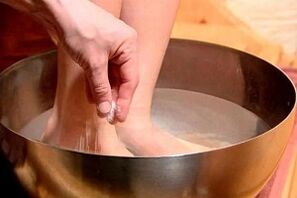
The initial stages of the fungus can be eliminated using folk recipes.With regular procedures, the results will be apparent.
Folk remedies cannot independently eliminate fungal spores, but they have certain antibacterial and antiseptic effects.
As auxiliary medicines, preparations prepared according to folk remedies are very effective.
The use of traditional medicine methods requires permission from the attending physician.
Based on the comments, the following provided effective help:
- Take a bath with soda and salt.1 tbsp.Dissolve salt and soda in 2 liters of water and add 10 drops of iodine.Soak your feet in the solution for 15 minutes.This procedure is performed before the use of antifungal agents.
- Take a bath with potato peel soup.Soak your feet in the broth, reduce to a comfortable temperature for 20 minutes, then wash.This procedure is performed once a day until symptoms disappear.
- Bathing with Poplar Bark Decoction.Pour 100 g of crushed bark into 500 ml of boiling water and cool.Add the resulting infusion to the bath.
- garlic ointment.Crush 2 large cloves of garlic into a paste and mix with 100 g of butter.Apply the ointment to steamed skin for 10-15 minutes a day for a month.
- Decoction applicationHerbal medicine.Pour 2 tablespoons of chamomile, chamomile and violet into a liter of boiling water and let it sit for 2-3 hours.Apply gauze soaked with the infusion to the inflamed area for 30 minutes a day.
- Press burdock leaves into tablets.Beat fresh burdock leaves with a hammer, wrap your legs in them, secure them with a bandage, and put on socks.Change dressings 2 times daily.Course duration is 21 days.
- Apply with carrot juice and vinegar.1 tbsp.Lake Mix carrot juice with 9 percent vinegar and apply it to the inflamed area with a tampon.
- Egg and vinegar ointment.Pour raw eggs into 100 ml vinegar essence (70%) and let it sit for 7 days.Mix the dissolved eggs with 100 g of butter and beat.Lubricate the steamed legs with the resulting lotion, wrap them in a film and put on socks.Repeat this process daily until the fungus is completely cured.
- Compressed with ammonia.Add 1 tablespoon to 200 ml of water.Lake ammonia, soak gauze in the solution, wrap your feet in it, and put on socks.The compress is applied in the evening and continued until morning.The total number of procedures is 9-10.
complication
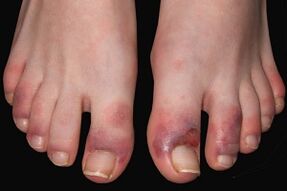
Fungus on toes is more than just a skin problem.
The infection spreads throughout the body and penetrates the bloodstream, affecting internal organs and negatively affecting the functioning of the entire body:
- Long-term exposure to mycotoxins can cause allergic reactions and aggravate bronchial asthma and dermatitis.
- Penetrating into the bloodstream can disrupt the function of internal organs.
- Deep mycosis leads to the progression of diabetes, and gangrene and bone infection may occur in its background.
prevention
An organism with a strong immune system can fight against any infectious disease.Therefore, the main measure to prevent fungal infections is to maintain the body's defense capabilities.
Following the following hygiene rules will help you avoid contracting fungal spores:
- Change socks and pantyhose daily;
- Breathable shoes made from natural materials;
- Wear special shoes (slippers, flip-flops) in public places;
- Use special protective sprays to care for the skin of your feet when going to swimming pools, bathrooms and beaches;
- Get a pedicure at a trustworthy salon where the equipment is properly sterilized;
- Wear disposable socks to try on shoes in the store.
Special attention should be paid to preventing fungal reinfection after treatment.
To prevent spores from persisting on various surfaces, they need to be antiseptic treated with a 45% vinegar solution.
It is recommended to change towels and slippers.
Treat the rest of the shoe from the inside with the vinegar solution and place it in a plastic bag for 12 hours.
Boil sheets, socks, pantyhose, and towels in a soap and soda solution for 10-15 minutes.
Fungus on the toes cannot be ignored, so it is recommended to consult a doctor at the first symptoms.
Prompt treatment allows you to deal with the fungus quickly and avoid complications.Fungal diseases should be treated until symptoms have completely resolved and the skin has recovered.